Activities · Art · Hobbies

Hobby Piece – National Gallery of Ireland

In celebration of St. Patrick’s day this week, I thought I would share with you one of my hobbies and one of my favourite places ever – art galleries or to be more specific the National Gallery of Ireland.

Before I start talking about the gallery itself, I have to tell you about my love for Ireland. Personally for me, Ireland is not only a place of beauty, a treasure chest of discoveries, but it is home to some of the friendliest people I have ever met.

The National Gallery of Ireland has a special place in my heart because it was the first gallery I had ever been to which actually made me fall in love with art. Living with multiple chronic illnesses I find it hard to switch off and truly relax and divulge myself in actual mindfulness, but the National Gallery made me do just that. It was the first place in the outside world to really make me stop and engage with something other than how unwell I felt, because let’s face it when you are out and about it is hard not to let the pain and fatigue consume you.

I have been to the gallery on three occasions – one of which was to see the Vermeer exhibition – and the most recent visit being after the revamp in 2017 which sadly I was unable to finish seeing all the way through due to time constraints. Unfortunately my health has taken a battering in the years since, but my goal is to go back and see EVERYTHING (although maybe over a few days – to make sure it isn’t too much for my body in one go!).

The Gallery Itself

The National Gallery of Ireland is in Dublin, and is home to Irish and European paintings and sculptures as well as paper prints, drawings, photographs and watercolours. It was founded in 1854 and has over 16,300 artworks.

My favourite pieces (the ones I have seen at some point) include:

  • CaravaggioThe Taking of Christ – This painting purely blew me away, so much so I have my own print copy. This painting is a depiction of when Judas betrays Christ, and the figure at the back is thought to be Caravaggio himself. I love the play of dark and light contrasts in this piece and the hidden meanings throughout.
  • Johannes VermeerWoman Writing a Letter, with her Maid – Vermeer is no doubt, one of my favourite artists and this was only confirmed in my visit to the Vermeer exhibition many moons ago. Again this painting exudes light focusing on the figures of the woman and her maid as well as discarded items on the floor. I love the mystery of this piece as you don’t know who the women is writing too, but can assume it is a love interest.
My Vermeer Exhibition book and My National Gallery of Ireland Companion Guide
  • George BarretView of Powerscourt Waterfall – It would be rather rude to talk about an Irish gallery and not mention an Irish artist and scene. This piece focuses on the natural scene of the tallest waterfall in Ireland and is truly beautiful. I love how the power of the waterfall jumps out at you through the trees, yet still makes for a peaceful scene.
  • MurilloThe Prodigal Son series – There is actually six paintings in this collection by Murillo which tells the story of the prodigal son. I love this idea of having separate paintings to tell one story and first discovered this on the gallery’s online exhibition. I also love the use of colour in Murillo’s work which I also enjoyed in his ‘The Holy Family’ piece.
  • James Arthur O’ConnorA Thunderstorm: The Frightened Wagoner – My final selection is of a thunderstorm scene which is packed with drama. One of my favourite things to examine in art is that of natural scenes and O’Connor has captured this magically. From the heavens opening to the bolt of lightening, the scared horses to the ferocious water under the bridge and the physical feeling that the trees are moving in front of your eyes – this piece catches nature in it’s rawness.

Accessibility in the Gallery

Although at the time of writing this the gallery is closed due to Covid – I thought it would be a great idea to share with you the levels of accessibility at the gallery in case you ever tempted to take a look yourself at some point.

The gallery has a wide range of resources available and has an excellent tool known as the accessibility map which outlines the provisions it makes for visitors with mobility issues, deaf or hard of hearing, blind or have low vision, and visitors with other disabilities. To view the map check out the gallery website.

For people unable to physically attend because of their chronic illnesses, the gallery has many resources online including podcasts, the online collection, online exhibitions and even pieces to practice mindfulness on.

I hope you enjoyed today’s hobby piece and it has been of interest to somebody somewhere. Either way I really enjoyed writing it because not everything is about illness and sometimes it is nice to remember that.

Activities · Chronic Illness · Mental Health

Enjoyable Things To Do When Living With a Chronic Illness

I am not going to lie to you, the last few weeks have been tough. I have been feeling unwell with a host of symptoms old and new. Today has been a better day and I wanted to get a post out, albeit short and sweet.

With this in mind, I wanted to hone in on enjoyable things to do when you are living with chronic illness. As always these things are dependent on energy levels and what symptoms are bothering you at the time, BUT it is always worthwhile having some things in your back pocket for those better days.

Enjoyable things to do:

  • Reading and/or listening to audio books
  • Listening to music
  • Painting
  • Crafting
  • Getting outside
  • Photography
  • Writing
  • Soaking in the bath
  • Watching TV/Films
  • Baking
  • Going through old photos and reminiscing
Photo by Valeria Boltneva on Pexels.com
  • Daydreaming
  • Learning
  • Relaxing
  • Remembering how far you’ve come
  • Reading/hearing inspirational quotes
  • Planning
  • Watching comedy clips and laughing
  • Dancing
  • Listing things you like about yourself
  • Doing something for someone else
  • Eating

I wonder how many of these activities you can relate to when it comes to finding enjoyable things to do. Maybe you have your own that you would like to share….

Activities · Chronic Illness · Goal Setting · Goals · Mental Health

The Pros and Pressures of Goal Setting with a Chronic Illness

We are officially making our way to the end of January already, and by now I am sure there are many people binning their new years resolutions, promising themselves they will start again soon.

This January 1st I made the decision for the first time in many years to not make new years resolutions. Why? Because I never ever complete them and as a result end up berating myself for my inability to achieve what I set out to do.

For anyone chronically ill or not, resolutions can be hard to keep, so why do we bother doing them at all? Maybe it is because a resolution is a firm decision to do something and that can be too much of an ask especially on bodies that don’t play ball. This is where we enter the world of goal making.

If you are like me and have been to anxiety and depression workshops or spoken to mental health practitioners, you will know goal setting is a vital tool used in the management of anxiety and/or depression. You may have also heard of the theory of using SMART when it comes to setting goals to make them more achievable. Specific Measurable Achievable Realistic Time-limited goals are deemed easier to accomplish.

Goals are a great source of focus when it comes to dealing with mental health as a way of giving yourself direction, motivation and confidence when you can see your achievements taking place. But how useful are they in chronic illness?

As someone who has multiple chronic illnesses and someone who has suffered with mental health issues I find goal making a juggling act. My mental health needs a focus, to feel like I am working towards something, but setting goals also brings out the ‘pre-chronic illness me’ – the person who cannot stop until something is finished, the person who overthinks, over plans, who wants to overachieve, and therefore puts the ‘me of today’ at risk by pushing my chronically ill body beyond it’s limits.

Of course there is no ruling saying you need to achieve each goal on the day you say you are going to do it, yet it doesn’t stop me from trying. To top it off on the days when it is so physically impossible for me to do so, I play the blame game with my own body for not allowing me to tick it off the list.

Photo by Markus Winkler on Pexels.com

So what is the answer?

I think goals are a useful tool for most people, but I think personally for me adapting the format they take in my life is key. Using the SMART goal system whilst useful needs fairly generous adaptations to fit in with chronic illness life that as many of us know is so unpredictable.

My adaptations include:

  • Adjusting the goals on a regular basis inline with what my body needs at that moment in time. E.g. If I am struggling with my symptoms I will change my goal specifics each week (if indeed I am able to do anything at all) to determine what I am capable of each week/day.
  • Taking regular breaks from goal setting – Having my mind constantly set on achieving goals brings out the ‘me’ before illness and whilst I believe it is important for me to have a focus, I also think it is important for me to have times where I am not preoccupied with trying to achieve something. At times it is nice just to be and deal with what is happening right now.
  • Learning to be kind to myself – This really is a work in progress because I often find myself falling into bad habits, but reminding myself it is ok if I haven’t completed a goal on the day I had scheduled to do it, because it is not my fault can be helpful thinking.

In conclusion, goal setting is a great tool to have in your ‘medical toolbox.’ Goals can work wonders for your mental health and give you a sense of reward, however as always it is always vital to factor in your chronic illness needs in line with that. Pushing yourself is something your body won’t thank you for, so always be true to yourself and remember just because something didn’t happen today there is always tomorrow.

Activities · Christmas · Chronic Illness

Top 5 Christmas Activities for Chronic Illness Warriors

Seeing as people seemed to enjoy my post back in the summer about the top 5 summer activities for chronic illness warriors, I have decided to do a Christmas version.

Christmas is traditionally seen as a time of year which is full of fun with never ending events and things to do. However when you are chronically ill some of these activities may not be appropriate inline with your body’s needs and your energy levels.

As we all know this year is going to be a very different year anyway, but I would like to share with you my top activities at Christmas when you have chronic illnesses.

1 – Feast on festive treats

One of the best things to do at Christmas time is snuggle up on the sofa with a big Christmas sweater and enjoy a nice mug of hot chocolate (marshmallows and cream are hard to resist!). Perfect for a chronic illness warrior because you are not only getting a festive treat, but you can relax on the sofa whilst doing so and stay true to your normal attire of baggy clothes for comfort just with a funky festive flare. Obviously this is allergy and diet dependent, so you may need to make adjustments where needed, but this time of year there are many Xmas foods you can divulge in.

Photo by Taryn Elliott on Pexels.com

2 – Watch Xmas films and/or tv

Watching films and/or television is a great chronic illness activity as it allows you to chill out and relax on the sofa or in bed without much physical activity. Christmas films and shows are a great form of escapism which in turn can give you a focus on something other than feeling unwell. Remember you can adapt this activity to your individual needs by choosing the length of film/programme you watch and deciding if this is an activity you would like to do alone or with others. For ideas on the best Christmas films to watch you can check out my blog post on my top Christmas film picks here.

3 – Sale shopping

I did debate a bit about whether to add this to the list because I am aware shopping (physical or online) can be very energy draining especially on a time line. I for one find shopping an activity which can wipe me out for days on end even if it is done through my computer. However if like me you find being chronically ill greatly effects your finances then finding bargains in the sale can be a lifeline on items you desperately need, but cannot normally afford. If doing this yourself is too difficult maybe you could put a list together of things you particularly need and ask someone else to do the investigating for you!

Photo by Karolina Grabowska on Pexels.com

4 – Give back to charity

When you live with chronic illness a lot of your time can be taken up with having to think about your own needs (and how most of the time you are not listening to them), but Christmas is that time of year when you can be thankful for what you do have. Giving to charity is a wonderful way to allow yourself to take a moment and reflect on other people who are in the same boat as you (or worse) and make donations to the charities who are a lifeline to people in their moment of need. Remember it is not about the amount, but the thought and your donations do not have to be financial, they can be time or task related instead.

5 – Look to next year

As I have already mentioned Christmas is always a reflective time of year. The time of year to think about the year just gone and the new year ahead. Living with chronic illnesses this is maybe more poignant than it is to most others. Going into a new year unfortunately is not going to cure us or in most cases make us any better, yet that doesn’t mean you shouldn’t have hope and goals for the future. I was always somebody who would make new years resolutions and beat myself up for not being able to achieve them when really they were always going to be unachievable with my conditions. Instead of making new years resolutions why not highlight your achievements for the year and remind yourself of how amazing you are, and how you can take these skills with you into the new year.

Photo by freestocks.org on Pexels.com

So here you have it – my top Christmas activities for chronic illness warriors. Hopefully you find these suggestions helpful, but remember there is no right or wrong. Your Christmas should be spent in your way, so enjoy!

Activities · Christmas · Films

Christmas Films – My Top Picks

Following on from my top Halloween film picks, I couldn’t resist sharing my top films for Christmas. Christmas can be a very difficult time for people with chronic illness due to the various activities, communications and heightened visual and audial disturbances, but watching films can be a great activity to do with others or alone. It is just a case of picking the right one so let’s get started….

Let’s get right to the crunch and dive straight in with proper xmassy films: The Santa Clause and Elf.

The Santa Clause is one of my most favourite Christmas films of all time. Starring Tim Allen the movie is about a father who transforms into Santa. This is a great watch if you enjoy seeing the north pole in all its glory and love the magic of believing. Keep a look out for the various elves in particular Judy who makes the perfect hot cocoa.

Elf starring Will Ferrell is a must see for Christmas fanatics. The movie is centred around the story of Buddy – a human who was raised by elves – who after discovering he is not an actual elf goes on a journey to New York City to find his biological father. This film is filled with festive cheer as Buddy explores this new world with an elf mentality. – Son of a Nutcracker!

Ok so I know not everyone loves a Christmassy film at Christmas so let’s take a look at my top non-Christmassy films that are considered Christmas films – if you catch my drift: Bridget Jones’s Diary and Home Alone.

Bridget Jones’s Diary is a romantic comedy that definitely resonates with me. Starting at a Christmas party with that disastrous Christmas jumper and Bridget trying to combat single life. That soon changes however when she has two men vying for her affection in the form of Daniel Cleaver and Mark Darcy. The movie has some great scenes and funny moments especially in the form of Bridget’s friends alongside a very catchy soundtrack.

Home Alone is the ultimate Christmas comedy about a young boy being left you guessed it – home alone. I think most people probably know the story by now and if you don’t I really recommend you watch it. There are some great performances especially by a young Macaulay Culkin and is definitely a great pick if you want a few laughs over the festive period.

So we have the Christmassy and the not so Christmassy films, but now I want to share some shorter stories for my fellow chronic illness warriors who may find viewing longer films too much on their bodies. I give you Raymond Briggs’s The Snowman and Father Christmas.

The Snowman – This Raymond Briggs’s classic is a visual masterpiece and so beautifully crafted. It is also the story that brought us Walking in the Air and a lot of flying snowmen. For such a short story it sparks the magic and excitement of Christmas as well as a slight tearjerker at the end (I won’t spoil it for you).

Father Christmas – Again this Raymond Briggs’s classic has the same visual beauty, but this time follows Father Christmas on his year from one Christmas eve to the next. This has a funnier element to it then The Snowman, with Father Christmas getting up to all sorts of adventures.

For the eagle-eyed viewers amongst us you may notice that both short stories give cameos to each other with The Snowman featuring in Father Christmas and Father Christmas featuring in The Snowman, so it is a lovely nod to each story. If you want something short that gets you in the festive mood I strongly recommend this picks to make you smile.

Here we have it my top picks for Christmas – of course there are many others, but I wanted to keep it simple. So what will you be watching this year?

Activities · Christmas · Chronic Illness

Low Cost/ Low Energy Gift Ideas for Others

There is no getting away from it – Christmas is getting closer! Seeing as it is the season for giving I thought it would be a good idea to talk about gifts you could give to your loved ones. I for one absolutely love the festive period, but living with chronic illnesses I find a) I don’t have the funds to buy elaborate presents for others and b) I don’t have the energy for boundless shopping (even if it is online).

With this in mind I have tried putting together five gift ideas which are low cost, easy to source and don’t require too much effort. Hopefully these inspire you to put together your own gifts, so enjoy getting creative!

Gift Idea 1 – Themed Jar

This idea is pretty simple all you need is a mason jar of any size with an idea of what the recipient likes and fill it. This could be in the form of beauty products, art accessories, socks, a specific hobby etc. Last year I actually used a bucket rather than a jar and filled it with car accessories as my relative had got a new car. For the purpose of this post I have chosen a baking jar.

My baking jar contains:

  • Reindeer and Christmas Tree cookie cutter
  • Pack of sweets
  • A glass bottle containing Golden Hundreds and Thousands
  • A glass bottle containing Silver Edible decorations
  • Red and green decorating icing
  • Wafer daisies
  • Spotty fairy cake cases

To decorate the jar I used crafts I had at home including a reindeer ribbon and a wooden tag with a Christmas tree print.

Gift Idea 2 – A Christmas Decoration/A Snow Globe

This was probably my most favourite item to make because it is very straight forward yet looks very pretty and gives that personal touch. Once again you need a humble mason jar, some simple decorations (which you could take from your own tree) and some fake snow.

If you want to make this as a simple decoration like mine all you need to do is add all your bits inside the jar, but if you would like to make it as a snow globe glue your decorations to the lid so when you shake everything stays in place.

My Christmas scene includes:

  • Faux snow
  • Snowman decoration
  • Post box decoration
  • Berry decoration (held in snowman’s hand)
  • Cone with wire
  • Blue sparkly ribbon

Gift Idea 3 – Little Box of Love

This idea is very similar to the jar ideas, but on a smaller scale. Again you can pick any theme you would like or choose lots of random items. I chose to make a stationary box which I decorated myself with my own crafts and filled with tiny stationary items.

My Little Stationary Box includes:

  • A wooden box (already made) – which I decorated with paint, and stocking, skates and snowflake sticker embellishments.
  • Pen
  • Stapler
  • Staples
  • Rubber
  • Gel pens
  • Key ring (not very stationary I know!)

Gift Idea 4 – Chocolate Bags Best Low Energy Option

If crafting is not your thing or is too energy consuming then an easier option would be choosing someone’s favourite chocolates or sweets and presenting them in a cute Christmas bag. Who doesn’t like delicious treats at this time of year?

My Chocolate Bag includes:

  • Cellophane Santa bag
  • CHOCOLATE – Remember by doing this yourself you can cater to allergens and vegan options if needed.

Gift Idea 5 – Memo Memories Best Low Cost Option

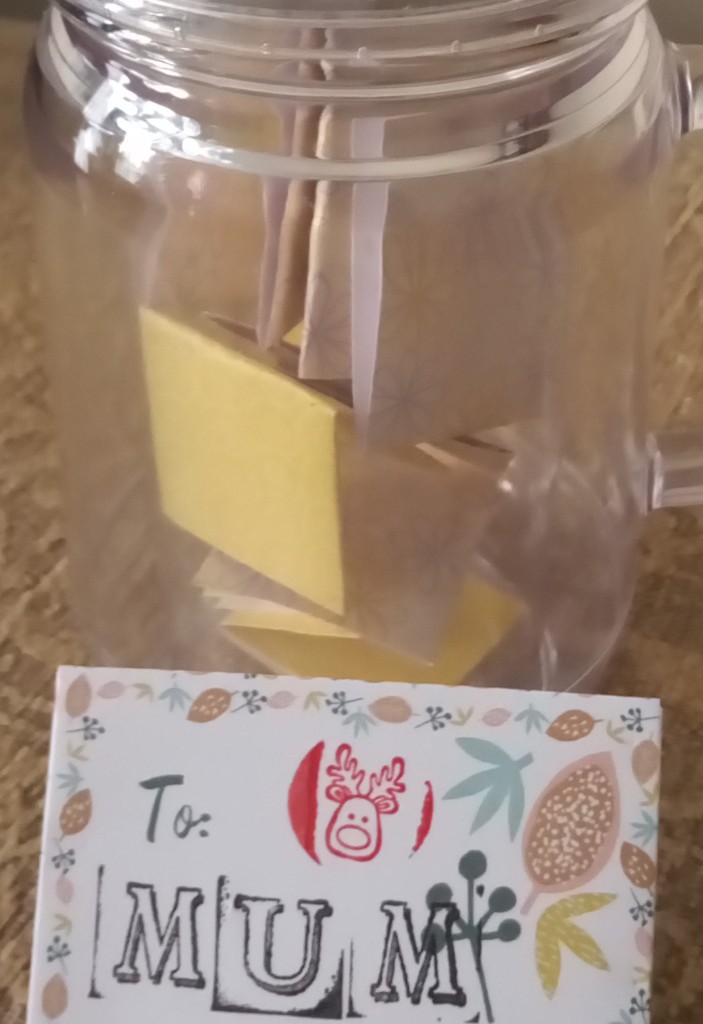
This option is for anyone who is finding money a real difficulty this year (or any year) – I feel you and trust me I am using this myself. This is actually probably the most thoughtful gift of the lot which will mean so much because it focuses on memories. You can use any medium you like whether that be a box, a jar, a container or even an empty cereal box – anything you can find in the house.

Got it? Great now all you need is paper and pens – again in whatever form you have them. Craft paper, wrapping paper, plain paper, card whatever you have. As long as you have enough to make say 10 (maybe more) squares which you can add writing to. Once you have made your squares all you need is your imagination.

On each square write a memory, a film, a song lyric, a photo anything that is personal between you and the person you are making it for. Once you finished them, fold them up and drop them in your container with a little message to the recipient to take one out when you see fit. Maybe one every day for the 12 days of Christmas, or when they are feeling sad, or when they want to think of you. The point being it should be a great way to remind them of why you love them and the happy times you have shared together – what could be better than that?

So there you have it my five ideas for low cost (hopefully low energy) gifts for others. Remember it is the thought that counts and there is no rush with how long it takes you to put things together. Remember there are always gift vouchers!

Activities · Chronic Illness · Mental Health · Stress Management

Gratitude Lists

Living with chronic illness it can be difficult at times to see the positives in your life. What with the endless mental and physical symptoms attached to your condition/s, in some cases the inability to work, be financially stable, have your own property and maintain relationships – life can be very difficult.

The last month has been a trying time for me with my conditions (which you can read about here) and I took a dip both mentally and physically. However the thing that has kept me going is the thing that always keeps me going – taking the time to appreciate what I do have in my life.

Gratitude lists are a great tool in realising that even in your most difficult times, there are still things in your life to be grateful for. No matter how small.

There are many ways you can create gratitude lists, it is just dependant on how much time you would like to dedicate to it. Some people may find writing one thing down each night that they have been grateful for that day helpful, whilst others may like to make a list in one go once a month. Alternatively you may find it useful to do one in times when you need a pick me up. The point is it should provide you comfort in your most difficult times and a go to resource to remind you why your life is good.

Photo by Miesha Maiden on Pexels.com

So what should you add to your gratitude list? This is a list which is unique to you so whilst you may have some generalised items you can have personal items specific to you too.

E.g. My generalised gratitude list includes:

  • Family
  • Access to food/drink
  • Roof over my head
  • The sun
  • The trees
  • Colours
  • Books and the ability to read
  • Warm bobble hats
  • Hot water bottles

E.g. My personal gratitude list includes:

  • My strength
  • Anyone who has helped me on my journey
  • My determination
  • My achievements big and small
  • My ability to keep going even when I want to give up

If you want to write daily gratitude lists, try and write about things that have happened to you that day which made you smile.

E.g. Wednesday gratitude list

  • Had a shower
  • Finished a chapter of my book
  • Had someone pay me a compliment
  • The weather

Another take is to give yourself themes to work around. From picking a season of the year (autumn) to a holiday you enjoy (Christmas), or even breaking down a gratitude you have already said and listing why you are grateful for it. You could even give yourself the alphabet challenge and list one thing beginning with each letter of the alphabet (if you can!)

E.g. My alphabet of gratitude includes:

  • A is for Air
  • B is for Blogging
  • C is for Countryside
  • D is for Dublin etc. etc.

Remember you can make it as serious or as fun as you want.

There you have it if there is one thing you do to make yourself feel better – make a gratitude list. There is no doubt life with chronic illness is hard, but remember to hold on to the little things in life; they are what will get you through.

So what are you grateful for?

Activities · Films · Halloween

Halloween Films – My Top Picks

Living with chronic illness it can be hard finding activities you can enjoy that are low energy, so with Halloween around the corner now is the perfect time (chronic illness or not) to emerge yourself in the world of film.

The genre of horror has such an array of different categories it really can be for anybody. From slasher to psychological and comedy to monster, the choices really are endless. So with this in mind I have selected my top films to watch this Halloween if you dare….

FYI – Please note all these films should only be watched if age appropriate – always check the certificate.

  • Kids Halloween Film The Witches

Let’s start gently with a good children’s Halloween pick (also ideal if you are not a big horror fan) and my top recommendation The Witches. You already know this is a great pick as it is based on the great children’s book of the same name by Roald Dahl. Although there is a new version for 2020 I still believe the 1990 version starring Anjelica Houston as the Grand High Witch is brilliant.

Runner up – Casper


  • Comedy Horror Shaun of the Dead

Runner up – Scary Movie


  • Splatter Horror Saw

People have very mixed views on the franchise that is Saw and the mastermind behind it Jigsaw, but for me Saw was one of the best horror franchises I have ever seen. As with a lot of films I found the very first film the best which centres around two men being chained up in a room and not knowing how they got there. The twists and turns are highly entertaining and the plot twist at the end was something I never saw coming. Not forgetting of course the array of games that are played throughout the film and the gore they produce.

Runner up – Hostel


  • Slasher Horror – Halloween

Runner up – The Texas Chain Saw Massacre


  • Supernatural HorrorIT

There are so many worthy supernatural horrors out there, but one of the most memorable is Stephen King’s IT because lets face it what’s scarier than a creepy looking clown? Pennywise (the clown) is actually a shape shifting monster who forces the characters to face their scariest fears. The film is actually split into two parts (so you need to watch the second film to get the whole of the story) as the children from the first film come back as adults and try to defeat the clown once and for all.

Runners up – Sinister and the Blair Witch Project (I couldn’t resist picking two!)

Photo by cottonbro on Pexels.com

  • Monster HorrorThe Babadook

Runner up – A Quiet Place


  • Psychological HorrorEscape Room

Now not everyone would call this a traditional horror as this film is about six people taking part in a mysterious escape room experience which quickly becomes more real than they were expecting. Watching the players go from room to room you feel yourself go along for the journey on the different challenges they face.

Runner up – The Belko Experiment

Other strong recommendations on my little list of horrors include:

  • Mama
  • Scream
  • Wicker Man

So here you have it my top film list for Halloween this year – what are yours?

Activities · Chronic Illness · Fibromyalgia · ME/CFS · Mental Health · Stress Management · UCTD

Action Plan for Seasonal Changes

Depending on your specific condition seasonal changes can make a huge difference to chronic illness both physically and mentally. Some people may even experience Seasonal Affective Disorder (SAD) which is a type of depression that is essentially affected by the seasons of the year. Before I was diagnosed with Fibromyalgia, ME/CFS and UCTD I was told I had SAD because I struggle predominately more in the autumn/winter months. I know now the reason for this was because the colder months made my conditions worse and therefore my mood lower. Although I do not have SAD as such I have found that some of the techniques I used in preparation of the colder darker months can help with chronic illness.

Preparation is key so in terms of my own experiences I am quite late as I normally feel the impact October onwards, so I would aim to start getting ready September time, but here we are mid October and I am only just beginning never mind!

Please note if you do suffer with SAD specifically then contact your doctor for more advice and information.

My first step on my action plan is to organise my winter drawer. Quite simply I select a drawer (or 2!) in my cupboard and a section in my wardrobe and fill it with my essential winter items. Items include jumpers, socks, tights, ear muffs, thermal tops and my most favourite item a bobble hat. Bigger items may include onesies, dressing gown, slipper boots, (although I wear these all year round), and hot water bottles. By having the items ready I don’t have to worry about finding them when the seasons hit and it is easier to throw things on without any debating when I am feeling not so great.

My winter drawer containing thermal vests, tights, socks, ear muffs and bobble hat

My second step is to organise myself. I do this by putting together some type of diary of course this would be helpful all year round, but I do find in the colder months my ability to stick to things wanes significantly as my symptoms affect me more. You can do this to record dates of importance, but to also plan things coming up to manage your energy levels more effectively. You can do this with a regular diary, an electronic version, or even a large wallchart/calendar. This year I have opted for an online calendar in order to plan any blogging bits I want to do which will not only help me manage my energy, but hopefully keep me motivated.

Photo by Bich Tran on Pexels.com

My third step is to brighten up my living space. Whilst there are many amazing things to enjoy about the autumn/winter months they can be quite dark, cold and often wet months, (in the UK anyway!), so I find it important to inject colour into my life in other ways. I do this by bringing out my colourful accessories and furnishings and things that remind me of warmer climates. Cue the orange and yellow cushions and the beach pictures!

My fourth step is to plan how I am going to get more natural light. Being chronically ill it can be difficult to get out the house at the best of times, but especially when it cold and wet. Whilst at this stage my plan is to have a short walk every few days to soak up the light the reality is that may become difficult. Other ways of dealing with this is for me to reposition my spot in the living room so I am sat next to windows, make sure my curtains are thinner to get more light in my room and to set up my sunrise/sunset alarm clock to help me with getting to sleep and waking up.

UPDATE – My sunrise clock is not working even after changing the bulb arghhh!

My fifth step is to look at the positives of the seasons. As I already mentioned the autumn/winter months have a multitude of amazing things about them, so it is important to remember it is not the seasons themselves that are the problem – it is the lack of light and warmth. The colours of autumn are beautiful and there are many things to look forward to regardless of how much energy I want to contribute to them. Events such as Halloween, Bonfire Night and my most favourite time of year Christmas – even though my body may be struggling they are great things to focus my mind on. If the winter is a real problem it may be an idea to start doing little bits for Christmas now, so it doesn’t become too overwhelming nearer the time.

Photo by Giftpundits.com on Pexels.com

So here you have it my 5 step action plan for the seasonal changes. Other things to consider are freezing meals, taking up a new indoor hobby, light therapy boxes (make sure to always do your research), eliminating stress as much as possible and the usual suspects in monitoring your diet and exercise pattern.

Remember the more you prepare now, the less pressure you will put on yourself later!

Activities · Books · Chronic Illness

Read a Book Day

Yesterday was Read a Book Day so technically I am late, but that’s living with chronic illnesses for you they don’t make planning easy!

Rather than talk about a self help book or a book about one of my conditions I wanted to share with you some books/authors that I absolutely love to read to escape my days of chronic symptoms.

Reading with chronic illness is difficult at the best of times especially when you experience fatigue; the book can be difficult to hold, the page can be hard to focus on, the fatigued invaded area which is normally your brain cannot take in a word that is being read, but on your good days reading can be magical. The key is to remember that reading isn’t a race and it doesn’t matter how long it takes. There have been times when it has taken me months to get through one book, but it was always worth it in the end.

I have mentioned in a previous blog post that there are ways of interacting with a book even if you can’t read it yourself such as getting someone to read to you, or listening to an audio book. You can also access books from your local library under the Quick Reads initiative which are much shorter than normal novels. My message being that nobody should ever have to miss out on the beauty of a good book.

My favourite books/authors:

Escape – C.L. Taylor

If you love psychological thrillers then C.L. Taylor is the author for you. Every book I have ever read by this author has been amazing so it was hard to pick a particular book. Escape is a psychological thriller with a difference. With never-ending twists and turns the reader finds themselves questioning characters up until the final chapter of the book. The family dynamics within the story were interesting to explore through the generations and I particularly loved the nods to the Irish culture – this is a definite must read.

I would also strongly recommend Sleep if you like a whodunit vibe. My next book on the list to read is Fear which is ready for me to start when I have the energy.

My next read

The Little Shop of Happy Ever After – Jenny Colgan

Another of my favourite authors is Jenny Colgan. Jenny’s books are the epitome of escapism which inspire hope for the future and as a chronic illness spoonie that is just what I need. Again it is incredibly difficult to pick a book as they are all so good, but I found the Little Shop of Happy Ever After particularly resonates with me. This speaks to anybody who would love to start again specifically anybody who would like to start again who truly understands the beauty of books. Another highlight in this book is the Scottish highlands setting and the people who live there.

I would also strongly recommend the Little Beach Street Bakery series which includes a summer and Christmas follow-up.

New Beginnings at Rose Cottage – Erin Green

New Beginnings at Rose Cottage is one of my all time favourite books. Firstly because it is set in beautiful Devon, secondly because I find the characters so relatable and thirdly because it offers hope for the future. Being chronically ill I often feel trapped by my situation and wish I could start again and this book inspires me to believe this is possible – in my head at least and to me that is what a great book should do. It should allow you to escape in your head even for a short while and allow to think of something else other than being ill.

So here you have it – it may be a little late, but these are favourite books and authors for Read a Book Day. What are yours?